 ultimate-guide
Does Performance Hunting Gear Keep Warm? Yes—Here's Why
Table of Contents
- Does Performance Hunting Gear Actually Keep You Warm?
- How Layering Systems Work in Performance Hunting Apparel
- Synthetic vs Down Hunting Jackets: Which Keeps You Warmer
- How to Stay Warm in a Tree Stand: Real-World Application
- Moisture-Wicking Technology and Thermal Regulation
- Budget-Conscious Layering: You Don't Need Premium Gear
- Maintenance and Longevity of Performance Fabrics
- Frequently Asked Questions
Last Updated: September 20, 2026
Does Performance Hunting Gear Actually Keep You Warm?
Yes, does performance hunting gear keep warm? The answer is yes, but only if you understand how it works. The difference between shivering in a tree stand at dawn and staying comfortable for hours comes down to one thing: layering systems. Most hunters grab whatever jacket feels thick and call it a day. That's where they go wrong.
The gear that performs best isn't always the most expensive or the heaviest. It's the gear that manages moisture while trapping heat. A well-engineered hoodie outperforms an expensive jacket that doesn't breathe.
How Layering Systems Work in Performance Hunting Apparel
A proper layering system is three separate jobs working together, not one jacket doing everything. Most hunters think "warm" means "thick," but thickness without strategy leaves you wet, cold, and miserable by mid-morning.
Base Layer: Moisture-Wicking Foundation
Your base layer sits against your skin and does one critical job: move sweat away from your body. When moisture stays on your skin, you lose heat fast. Merino wool and synthetic materials both work, but they work differently.
Merino wool regulates temperature and pulls moisture away even when wet, preferred in extreme cold. Synthetic materials dry faster, useful when moving between environments. Context decides which works best.
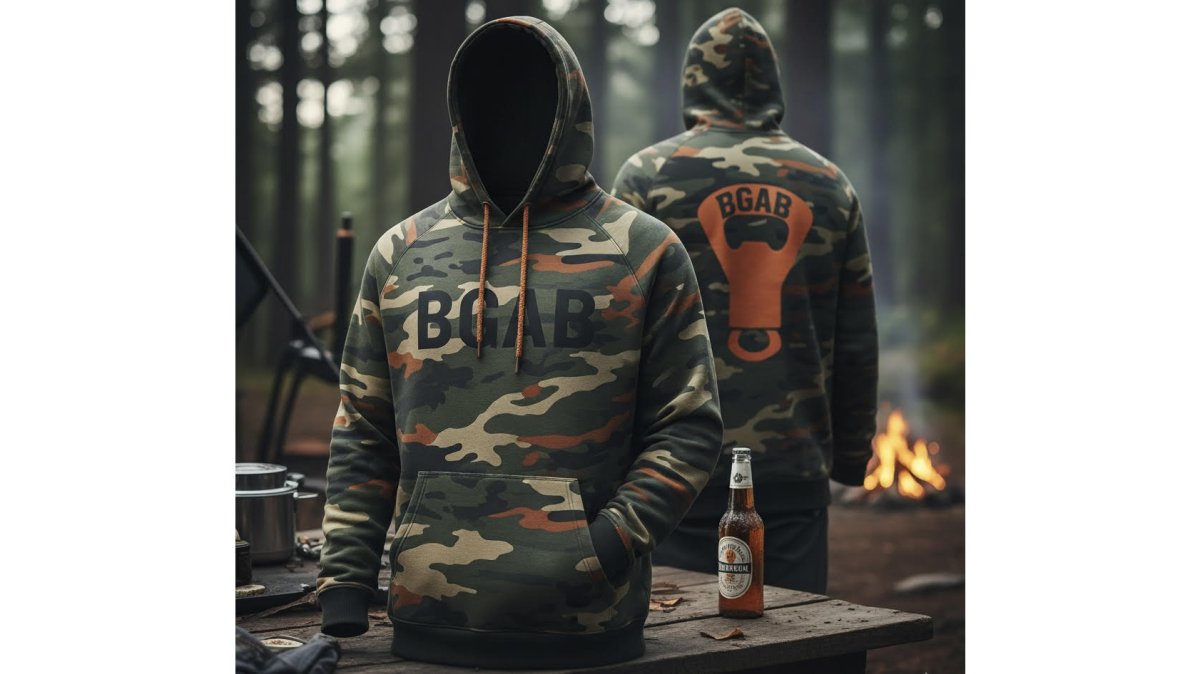
The BGAB Predator Hunt Hoodie uses a cotton-polyester blend with a fleece-lined hood.
Mid-Layer: Insulation and Heat Retention
Your mid-layer traps dead air space to keep you warm. Synthetic insulation maintains loft when damp; down loses power when wet. For wet conditions, synthetic wins. For extreme dry cold, down's superior warmth-to-weight ratio wins. A 200-weight fleece or thin synthetic jacket works, the key is having a mid-layer at all.
Outer Shell: Windproof and Waterproof Protection
Your outer shell blocks wind and rain. DWR (Durable Water Repellent) coating sheds light rain; waterproof membranes handle heavier precipitation but reduce breathability. A shell that doesn't breathe traps sweat moisture, defeating the system.
The BGAB Darkwater Camo Hoodie provides this protection with performance materials for hunting conditions.
Synthetic vs Down Hunting Jackets: Which Keeps You Warmer
This question has a real answer, and it depends entirely on your conditions.
Synthetic Insulation for Wet Conditions
Synthetic insulation works in damp environments because it functions even when wet. It's also more affordable and ready to use straight from the bag. The downside: synthetic is bulkier for the same warmth.
Down Fill Power for Extreme Cold
Down's superior warmth-to-weight ratio means a thin down jacket keeps you as warm as a thicker synthetic one. Fill power measures insulating ability, higher fill power means better warmth with less bulk. For stationary hunting in dry, extreme cold, down is the choice.
The real difference between down and synthetic comes down to this: synthetic works in wet conditions. Down works in extreme dry cold. Pick based on where and when you hunt, not on price or brand prestige.
How to Stay Warm in a Tree Stand: Real-World Application
Sitting motionless in a tree stand is the hardest test for any gear system because you're relying entirely on your clothing to retain body heat, which is why understanding does performance hunting gear keep warm matters most here. The real challenge starts before you climb the stand.

The Hike-In Problem: Metabolic Heat and Sweat Management
Most hunters dress for sitting still, then hike to their stand and sweat heavily. Once they stop moving, their body cools rapidly, but moisture is already trapped against their skin. Your body generates roughly 100 watts of heat at rest, but 300+ watts during a 15-minute hike. If your clothing system can't move moisture away fast enough, that wet base layer becomes a heat sink when you stop moving.
Dress cooler for the hike than you think you need. Wear base layer and shell, but leave the mid-layer in your pack until you reach the stand. You'll feel slightly cool during the walk, that's correct. Once at your stand, put on the mid-layer while still warm and slightly damp. It will trap residual body heat as your metabolic rate drops. Accept being slightly chilled for 15 minutes; the payoff is staying warm for the next four hours.
BGAB Hunt Predator Camo Hoodie →
Layering for Stationary Conditions
Once settled, start with a moisture-wicking base layer to keep moisture from pooling on your skin. Add your mid-layer, fleece or synthetic insulation, once you've stopped moving. This layer traps dead air space; a base layer alone provides almost no insulation. Your outer shell blocks wind, which accelerates heat loss. A windproof shell is essential.
Temperature Regulation in the Stand
Accept being slightly cool for the first 10-15 minutes after sitting, your metabolic rate is dropping and your clothing system hasn't yet trapped enough heat. If shivering after 20 minutes, your system is inadequate. If sweating, you overdressed. The goal is slightly cool at first, then neutral to warm. Note: extremities feel cold even when your core is warm, this is normal. If your hands are cold but your core is warm, you need insulated gloves, not a warmer jacket.
Moisture-Wicking Technology and Thermal Regulation
Moisture-wicking fabrics pull sweat away from skin through capillary action. The fabric has a structure that moves liquid away from the body toward the outer surface, where it can evaporate.
This matters because wet fabric loses insulating power. A cotton shirt soaked with sweat is colder than no shirt at all. Performance fabrics prevent this by keeping moisture moving.
Thermal regulation is about managing the microclimate around your body. Your body generates heat. Performance gear keeps that heat in while moving moisture out. It's a balance, not a one-direction flow.
What most guides miss: moisture-wicking doesn't mean "stays dry." It means moisture moves through the fabric instead of pooling on skin.
Budget-Conscious Layering: You Don't Need Premium Gear
The expensive gear isn't always better. A $200 jacket doesn't keep you warmer than a $60 hoodie if the $60 option has the right materials and fit.
Maintenance and Longevity of Performance Fabrics
Performance fabrics degrade predictably with poor care, and most hunters unknowingly destroy their gear within one season. Understanding why maintenance matters, and how to do it, extends the life of a jacket from one season to five.
How Washing Damages Moisture-Wicking
Hot water opens the fiber cuticles and allows detergent and minerals to embed in the fabric. Once embedded, these residues coat the fibers and block capillary action. A base layer washed in hot water will feel damp against your skin even when it's technically dry, because moisture can no longer wick away efficiently.
Correct Washing Protocol
Wash performance gear in cold water (below 60°F) with a mild detergent designed for technical fabrics. Brands like Hex Performance Wash or Nikwax Tech Wash are formulated to clean without leaving residue. Regular detergents leave buildup that degrades performance.
DWR Reapplication: The Forgotten Step
DWR (Durable Water Repellent) coating sheds light rain and snow. It's not waterproof, it's water-resistant. Over time, DWR wears off through friction, washing, and UV exposure. Most hunters notice their jacket stops shedding water after one or two seasons and assume the jacket is failing. In reality, the DWR coating has simply worn away.
Diagnosing Fabric Degradation
You can tell when performance fabrics have degraded:
- Base layers feel damp against skin even when dry, or moisture pools visibly on the fabric surface instead of wicking through. This indicates the capillary structure has been damaged or coated with residue.
- Insulated jackets feel less warm despite looking the same. This usually means the insulation loft has compressed. Down can sometimes be restored by gentle tumbling in a dryer on low heat for 10 minutes (no detergent). Synthetic insulation that has compressed is difficult to restore.
- Shells no longer shed water, water beads up briefly then soaks in. This is DWR failure and is easily fixed with reapplication.
- Seams leak or fabric tears easily. This indicates fiber degradation and usually means the garment has reached end of life.
Long-Term Durability Strategy
A performance jacket that costs $100-150 can last five seasons if maintained correctly, or one season if treated like cotton. The real cost isn't the initial purchase; it's the replacement cost of buying new gear every year because the old gear was washed incorrectly.
Frequently Asked Questions
What is the best way to stay warm while hunting in sub-zero temperatures?
The best approach combines three elements: a moisture-wicking base layer to pull sweat away from skin, an insulating mid-layer like synthetic or down for heat retention, and a windproof outer shell to block cold air. Merino wool and modern synthetic fibers both excel at regulating body temperature. Avoid cotton entirely, it traps moisture and loses insulating power when wet. Performance hunting gear from BetterGrabABeer.com, like the BGAB Predator Camo Hoodie, combines these principles in durable fabrics designed for stationary hunting.
Does synthetic insulation perform better than down for hunters in wet conditions?
Yes. Synthetic insulation retains warmth even when damp, while down loses nearly all insulating power when wet. If you hunt in rain, snow, or high-humidity environments, synthetic is the safer choice. Down excels in dry, extreme cold where its superior loft and packability matter more. Many serious hunters carry both options and choose based on weather forecast. The key difference: synthetic insulation maintains its thermal bridge resistance in moisture, while down does not.
How does moisture-wicking technology actually keep you warmer?
Moisture-wicking fabrics pull sweat away from your skin and move it outward through the fabric layers, where it evaporates into the air. This prevents the wet-clothing effect that causes rapid heat loss. When sweat sits against your skin, it cools you through evaporation, wicking prevents that. Base layers made from merino wool or polyester engineered for vapor transmission rate (MVTR) are most effective. This is why performance hunting gear outperforms cotton: cotton absorbs moisture and holds it, actively cooling you down.
Is expensive hunting gear worth the investment for staying warm in cold weather?
Not always. The warmth difference between a $60 hoodie and a $200 jacket comes down to insulation type and fabric quality, not price alone. Better Grab A Beer's BGAB Predator Camo Hoodie at $60 uses 75% cotton/25% polyester fleece-lined construction that works well for active hunting. For stationary tree stand hunting in extreme cold, upgrading to synthetic insulation or merino wool base layers makes a measurable difference. Budget-conscious hunters should prioritize proper layering over a single expensive jacket, three good layers beat one premium piece.